Poetry is Food; Food is Poetry
There are books that become comfort reads. These are books you return to in order to either be comforted or inspired. I have a comfort read for just about every genre out there. Some of these books I have carried with me for decades, like Starhawk’s Truth or Dare: Encounters with Power, Authority, and Mystery. Or Stephen King’s Misery. Or Jonathan Evison’s West of Here. Or, even, Caitlin R. Kiernan’s The Drowning Girl.
I do appreciate that the titles that are my comfort reads aren’t necessarily the most well known. But they are the most well known for me and how they changed my perspective or held my imagination, or exposed me to different landscapes and realms is more why any of us turn to comfort reads.
I read poetry fairly frequently. But I didn’t have a comfort read for the poetry category. I do now.
Pablo Neruda’s book The Sea and the Bells (translated by William O’Daly) has firmly joined the comfort-reads list. There’s something so intimate about this collection of poems that hit me right in the solar plexus. When you’re reading poetry and you are nodding your head, and mumbling, “yes, yes, yes” the writer has your attention not just when you’re reading, but it floats with you the rest of the day.
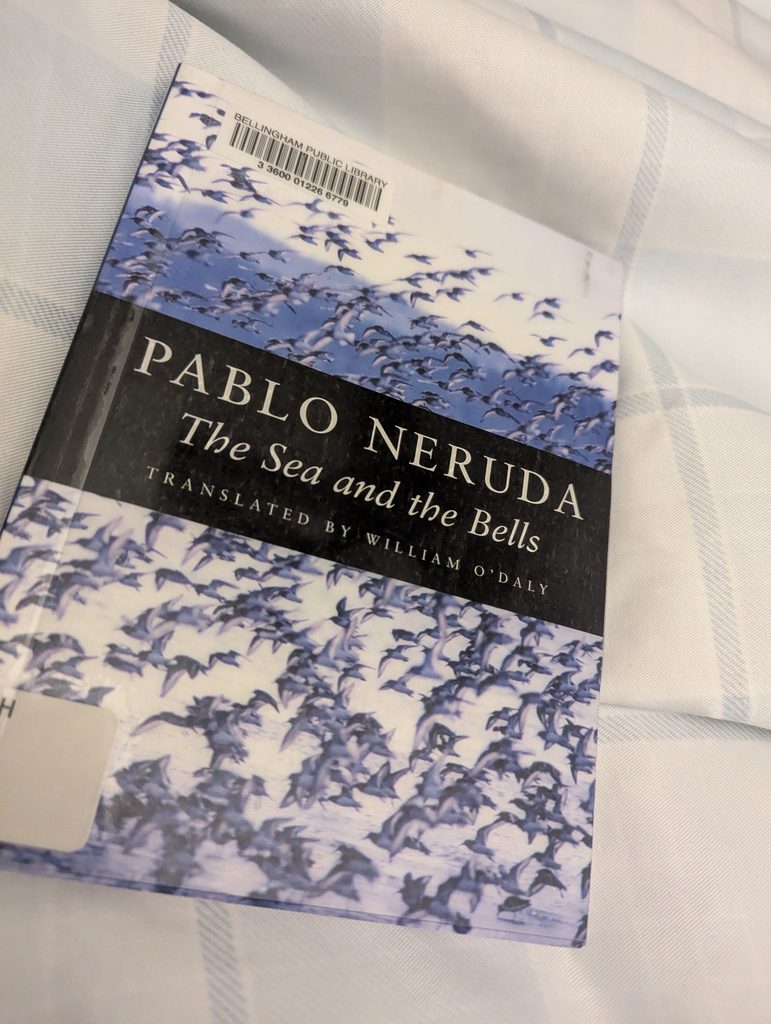
This was The Sea and the Bells for me. Also, because I feel like I understand Neruda’s desire to retreat from the noise of society. His love for nature, his wife, dreaming by the seaside is a heartsong for me personally. As the title suggests, the sea figures prominently in this book. As is the job of any poet to place us in the world as they see it – I could hear the crashing waves, the ringing of the various bells that dot the seaside. I could feel the love he had for the Land, his wife, and his country.
The fact that this is one of eight books of poems that Neruda worked on along with his memoir within the last year of his life, makes me feel the words are an urgent message from Neruda. He would die before that happened. His widow, Matilde, which figures prominently in his work had them published. And the world should be grateful for that, I believe. I am grateful for that.
Yet the volume is filled with this undercurrent of sad acceptance. Neruda was already sick when he wrote some of these poems. Ask anyone who has read this collection and they will tell you that the closing poem, ‘Finale,’ is devastating. Need to cry? Read that poem.
However, I am so enamored with ‘Salud!’ It is a salute to being kind in the face of terrible things, but being honest about it. It’s a nod and a chin wag to humanity’s truth that we all walk a path or have a story which the crowd about us has no idea about. It also makes me think about my elders and how they would always greet people along the street as they passed, as is the custom in Chile, where Neruda was born. In today’s world of long work commutes or remote working this kind of custom seems to have long past, but there was a story in this custom Neruda niggled under it and showed us, like any good writer does, the spiral of positive and negative all around a simple greeting.
This book displays each poem with the original Spanish on one side of the page, and the English translation opposite. Reading the Spanish version out loud and then re-reading the poem in English was an exercise in understanding for me, and I highly recommend if you read this volume, you try it that way, too.
I checked this one out from the library and now am on the hunt for my own copy to rest on my ‘comfort reads’ shelf. Neruda’s poetry feels like an old friend I can visit any time, so it deserves a spot there.
Grow Food For Free: The Sustainable, Zero-cost, Low-effort Way to a Bountiful Harvest by Huw Richards
This was an audio book for me, since Richards has a YouTube channel that I’ve long watched. His growing area in Wales is much like it is here in the PNW, and I’m always interested in how other people grow food. Richards has a deep permaculture background, too. The fact that the book is read by the author in his engaging Welsh accent was a bonus for me. It seemed to be a sound bath for some of my ancestors, as well.
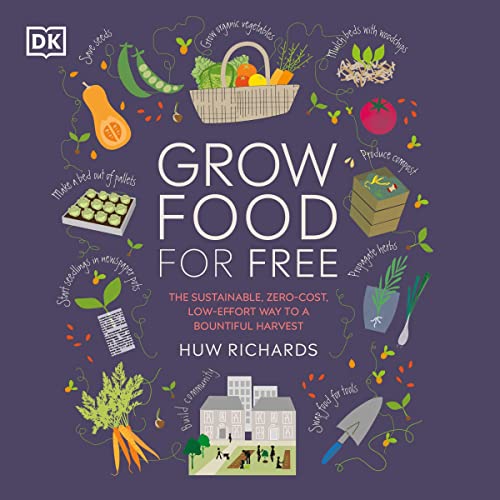
The books beginnings came as the author set himself a challenge to grow his own fruit and veg for a year. He succeeded and shares his tips, tricks, and tactics to fill your belly with homegrown food in this book.
He details some ways about sourcing materials, seed saving, composting, pest control, and even how he likes to eat some of the food (he’s a major beetroot fan). Some of the ways he sourced materials may be problematic for some readers/gardeners, mainly being cheered on with your goal to grow food. When I first started to turn what spaces I had into bringing in fresh food, there was confusion. Why would I want to grow basil when I can get it from the store. If you’ve eaten a strawberry straight from the garden or a tomato, or carrots, you understand.
Richards’ book focuses a lot about how friends, family, and neighbors all contributed to his challenge. Get yourself supporters like that and it will be a lot easier. Time is money, as we all know. Being able to delegate some of that sourcing helps these free food-growing a real possibility. If you do it solo, it will likely be harder.
The best thing about this book is that he really spends a lot of time talking about compost, and honestly, as a long time food-grower and permaculturist, this is the basis of any good food-growing efforts. For beginning gardeners you really need to understand this, and this book is great for that audience. Experienced gardeners may find that ‘there’s nothing new here.’
One word of caution to his tip to create inexpensive raised beds with old tires or pallets. As for pallets, this is definitely a low-cost gardening solution. Just make sure the wood is untreated. It should not be stamped with MB, which indicates it was treated with methyl bromide – a toxic chemical pesticide. Don’t use a pallet that has chemical stains on it. Skip painted or colored pallets, too. Look for HT or KD stamps on the pallets which indicate that the wood was safely treated.
Tires and the black plastic leach toxins into the soil and the roots of your plant take them up. You can grow non-edibles in tires, but I would paint them with an acrylic paint before employing them. That’s a whole other ask of your low-cost materials, however, and may be unapproachable for beginning gardeners. Instead, I would say, get on your local buy-nothing or craigslist free section. People give away raised beds and garden containers near daily – certainly seasonally. Don’t use tires to grow your food, friends. Just don’t. Even if you line it as Richards suggested with black visqueen before adding dirt. The tires
Next Month:
Queering The Runes: Reclaiming Ancestral Wisdom in Rune Magic & Mythology by Siri Vincent Plouff
This book has been in my TBR pile since it was released. I’m embarrassed it took me this long to get to it. But we all know the TBR pile is there to keep us reading. If there’s a book on Runes, you know I’m going to read it, as Runes have been my to-go-to divination tool and magic-making partner for decades. I’m always interested in how others approach it.
The Witch’s Name: Crafting Identities of Magical Power by Storm Faerywolf. Again another long-time TBR pile resident. I’m particularly interested in the sections on the history and mythology of spiritual names according to various cultures.
See you next month.