Runa Troy – Writing Witch – Blog
 Unlock with Patreon
This Week On The Covenstead – 10-12-2026
Cold Wake-Up Call
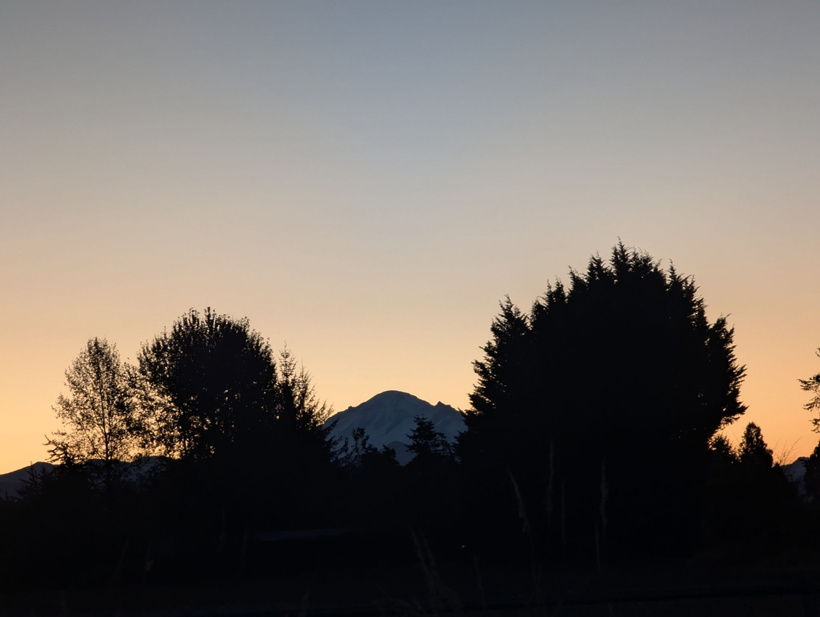 Dawn against Komo Kulshan (colonially known as Mount Baker) in Western Washington. (Photo by Runa Troy)
 The rising sun makes a torch out of Komo Kulshan. Photo by Runa Troy
I awoke today to our first hard frost. I was not prepared for 31 degrees F. But the stars in moonless sky were delicious. You could see Saturn in the western sky, reminding us to use today to build our best week channeling that Aries fire. The quiet enjoyed by those of us in the 5 a.m. club is unmatched. Despite the cold, the morning was glorious.
At this point in our calendar, the sun is rising right overall the valleys of Komo Kulshan. It becomes a soaring silhouette in the eastern skyline, its ice-capped point highlighting the sun’s blinking bright light over the fading leaves of the pumpkin patch. The sight of it seems to echo the knowledge that even in the waning season there is beauty and hope. The glaciers sparkle stronger, any and all light is celebrated, and the decay of the Summer nourishes the Land for a more fruitful Spring.
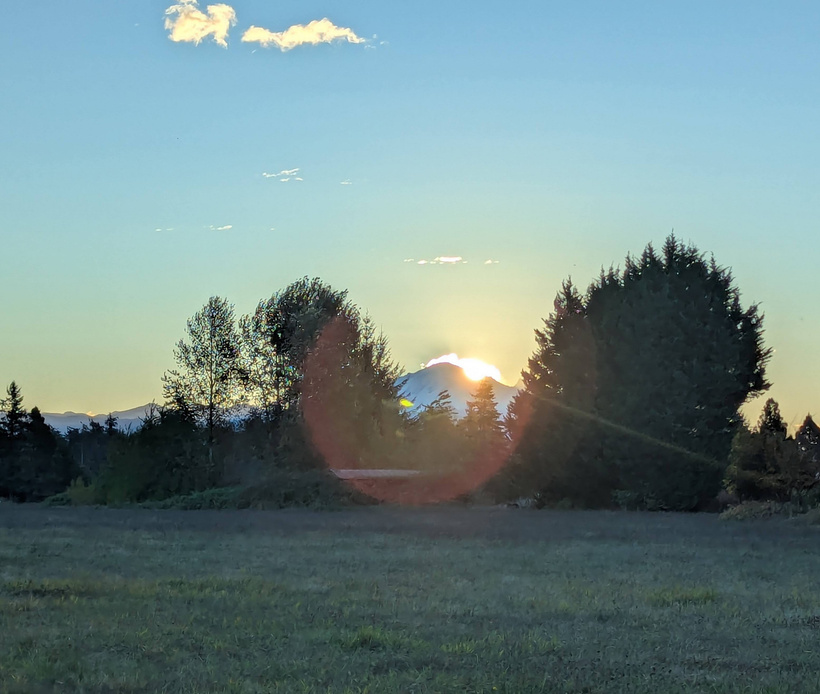 Looking for the beauty in spite of anything and everything is healthy. Photo by Runa Troy.
The first frost has me thinking about the season of Skaði, the season of hunting, the season of inwardness. That was reinforced with my Odin Pull this morning – Algiz. It is the Elk Rune and one that speaks of deep protection, especially during the season of the hunt, the season of those who came before. This season reminds us that we are a living and breathing being of ancestral optimism.
When all the crops have been harvested, shared, eaten, and preserved as possible, the season of migration, then begins the the hunting season. In the time when the Elder Futhark was the graffiti of the day, hunting continued the people’s survival. Standing in the cold this morning doing sun salutations and waiting to capture sun over mountain, I can feel the energy of those people running through my veins.
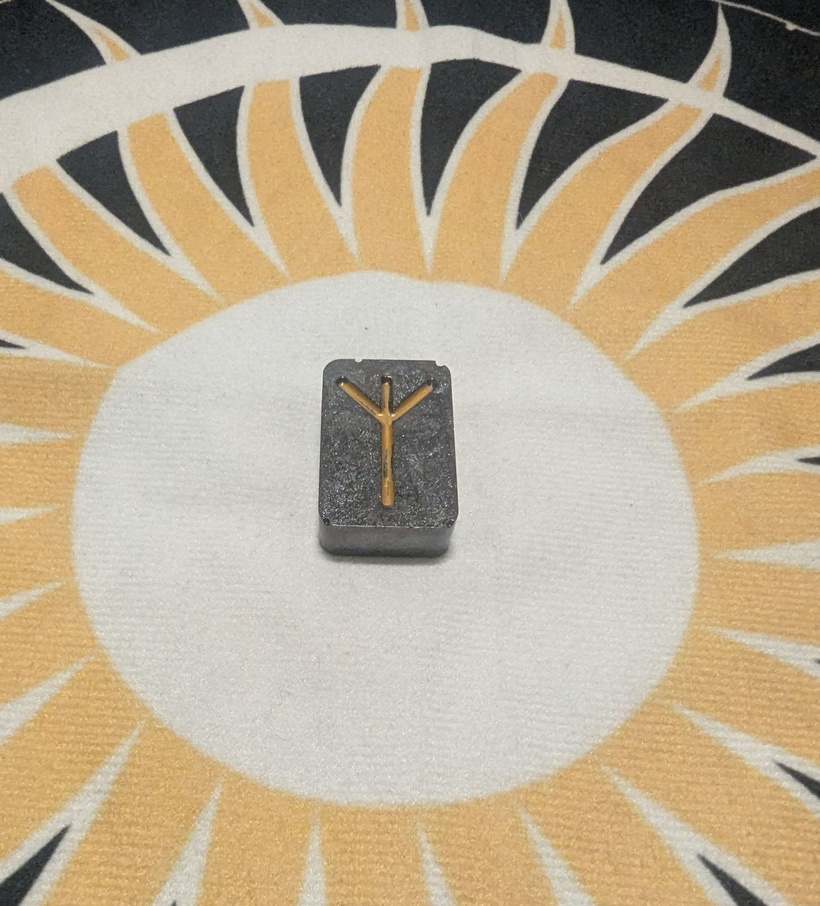 Algiz, the guardian Rune of the Elder Futhark, My Odin Pull today
The message this morning from them, from Algiz, from Skaði, is that as winter falls, we should embrace its arrival with enthusiasm – not defeat. These moments of quiet, of seeing the light in the dark, of moving with the Land, and courageously continue to strive to flourish in the delight of our ancestors, sparks a warmth that you can carry through to Imbolc.
I have more to say on the entire subject of Thresholds and Liminal Spaces, and that will be coming up here. In the meantime, I hope this week you find a way to hold fast to the gifts of winter like more time to read, cozy hot cocoa by the fire, never needing it to be cool enough to eat soup, and carving out even more time for your Practice.
Here’s some things to add to your Witchcraft-learning schedule:
At The Garden Gate: Thresholds and Liminal Spaces; Behind The Mask
Front-Porch Sitting: The Rebirth of the Witch Activist; Being The Spooky Kid at Halloween: A Half Century Later
Under The Willow: Autumn Divination
In The Witch’s Garden: Diversity in Practice
At The Witch’s Table: An Autumn Table of Magic; The Mysticism of the Hearth
Dream Circle: Overcoming Excuses in Dream Recording (Oct. 16); Dream Interpretation – Why You May Need Outside Help
Studio Squad: Seasonal Imagination Excursions (Oct. 14); Witches of Letters Workshop
We’ve been (re)creating a Witchcraft Learning Covenstead now for a couple of months – old hat for the many of you have returned to support my Creative Crone efforts. I appreciate you so much. Please let me know if you have any questions, comments, or concerns. Leave a comment here or email directly (runa@runatroy.com).
Blessed Be,
~R
In The Witch’s Garden: Wild Covenant – Lesson 1 -The Foundation of New Magic In Your Life
Witches of Letters – October 2026 Creativity Prompt
This Week On The Covenstead – 10-5-26
Under The Willow: New Moon in Libra – Rune Cast For October 10, 2026
Walking A Path With The Elder Futhark – Lesson 1 – Runes With Runa – 10-3-26
At The Garden Gate: BEE part of the solution
Boosting Creativity On The Covenstead
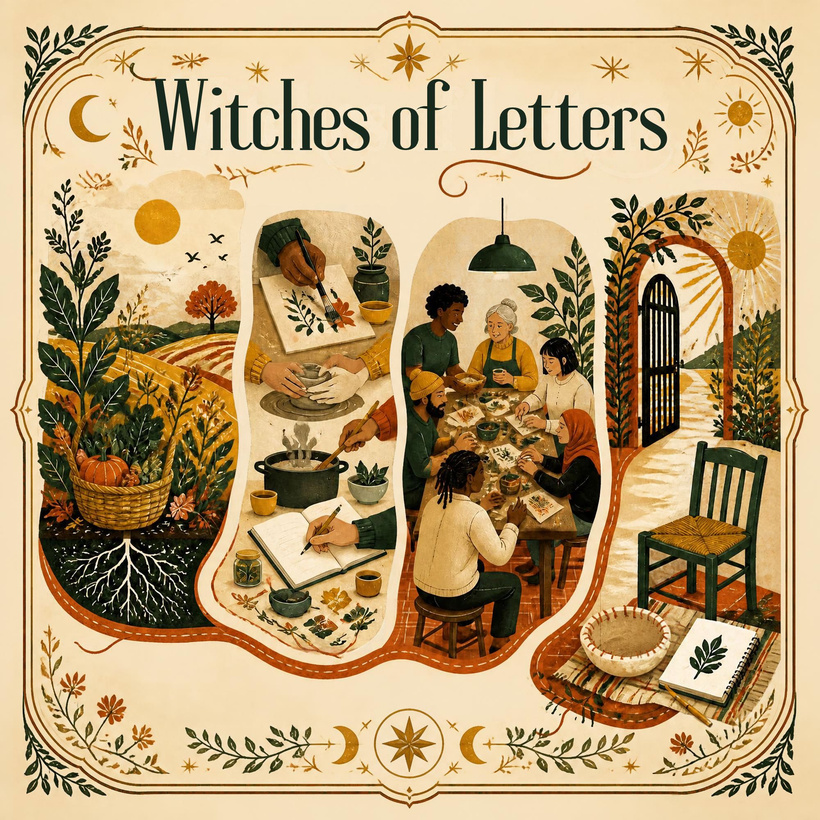 Join the Covenstead and be one of the Witches of Letters and Art Harder.
Get Ready for the Witches of Letters
Having opened a Patreon community, paused it, and now returned to it, I’ve learned a great deal. This return is more focused and fueled by my passion not only for the food web, but for the wider energy web of life in the cosmos. That web of energy also extends into the creativity each of us carries.
For me, artistic expression emerges through my partnership with the Land: cooking up Harvest Creations, brewing Kitchen Witchery, communing with Spirit, and – most centrally – writing and storytelling. With that in mind, and as I hinted at within a recent On The Covenstead post, I’m establishing Witches of Letters.
Witches of Letters will be a supportive space for esoteric, cross-disciplinary creatives. If you’re a witch, witch-adjacent, or simply a creative person drawn to magical ways of thinking, this group is for you. Whatever your medium, you’re welcome here. Together, we’ll develop creative skills, explore new ideas, and bring unfinished work toward completion.
Are you a painter, sculptor, musician, poet, photographer, designer, or something else entirely? You’re welcome within Witches of Letters. Writing will be available as one of the tools we explore, especially when you want to introduce, describe, or share your work, but you do not need to be a writer to participate. I’ve often said that more people listen to an album when someone writes about it. A new piece of software may need a story to help an audience understand its purpose. A photography exhibition may need pitches, descriptions, and supporting materials. Many forms of art benefit from thoughtful storytelling and context, while still remaining rooted in their own distinct mediums.
Witches of Letters creative prompts are open to all paid tiers of the Covenstead and will be posted regularly – monthly to begin with, although I hope to offer them more often over time. Studio Squad tier patrons will also receive a creative workshop each month. In these sessions, we’ll try exercises to inspire new work, learn about Imagination Field Trips, explore other artists’ practices, share work for constructive feedback, brainstorm ideas, and – when it feels right – dabble in witchcraft to support the creative process. In short, we’ll generate, develop, make, reflect, and refine.
Being a creative can be lonely work. We often begin by ourselves, and it can be difficult to maintain momentum without encouragement or accountability. A creative community offers support, structure, and fresh perspective. It gives you a respectful place to share ideas, experiment, receive thoughtful feedback and stay connected to your creative goals. Whether you write, paint, compost, design, perform, or work in another medium, connecting with others can help you see your work differently, move through creative blocks, and keep creating consistently.
That’s why I’m currently looking for creative witches to join the Studio Squad. This is my latest attempt to create a roundtable of witchy energy-weavers whose focus is art. These creatives will be the core group of the Witches of Letters. Studio Squad supporters will have access to Witches of Letters workshops, special seasonal virtual meet-ups, class lectures, mini-check-ins, practical exercises, craft discussions, research, work-in-progress readings, and thoughtful feedback.
Join the Covenstead at whatever level feels right for you, from Garden Gate to Studio Squad. Bring your ideas, your questions, and your unfinished work, and take the next step in your creative practice with a community that wants to see your work flourish.
The first Witches of Letters meeting will be Oct. 21, 2026 at 5:30 – 7:30 p.m. More details forthcoming, so get to the patron tier you’d prefer and, then – as they say – watch this space.
Art Harder, Witches,
~R
What The Witch Is Reading – September 2026
Poetry is Food; Food is Poetry
There are books that become comfort reads. These are books you return to in order to either be comforted or inspired. I have a comfort read for just about every genre out there. Some of these books I have carried with me for decades, like Starhawk’s Truth or Dare: Encounters with Power, Authority, and Mystery. Or Stephen King’s Misery. Or Jonathan Evison’s West of Here. Or, even, Caitlin R. Kiernan’s The Drowning Girl.
I do appreciate that the titles that are my comfort reads aren’t necessarily the most well known. But they are the most well known for me and how they changed my perspective or held my imagination, or exposed me to different landscapes and realms is more why any of us turn to comfort reads.
I read poetry fairly frequently. But I didn’t have a comfort read for the poetry category. I do now.
Pablo Neruda’s book The Sea and the Bells (translated by William O’Daly) has firmly joined the comfort-reads list. There’s something so intimate about this collection of poems that hit me right in the solar plexus. When you’re reading poetry and you are nodding your head, and mumbling, “yes, yes, yes” the writer has your attention not just when you’re reading, but it floats with you the rest of the day.
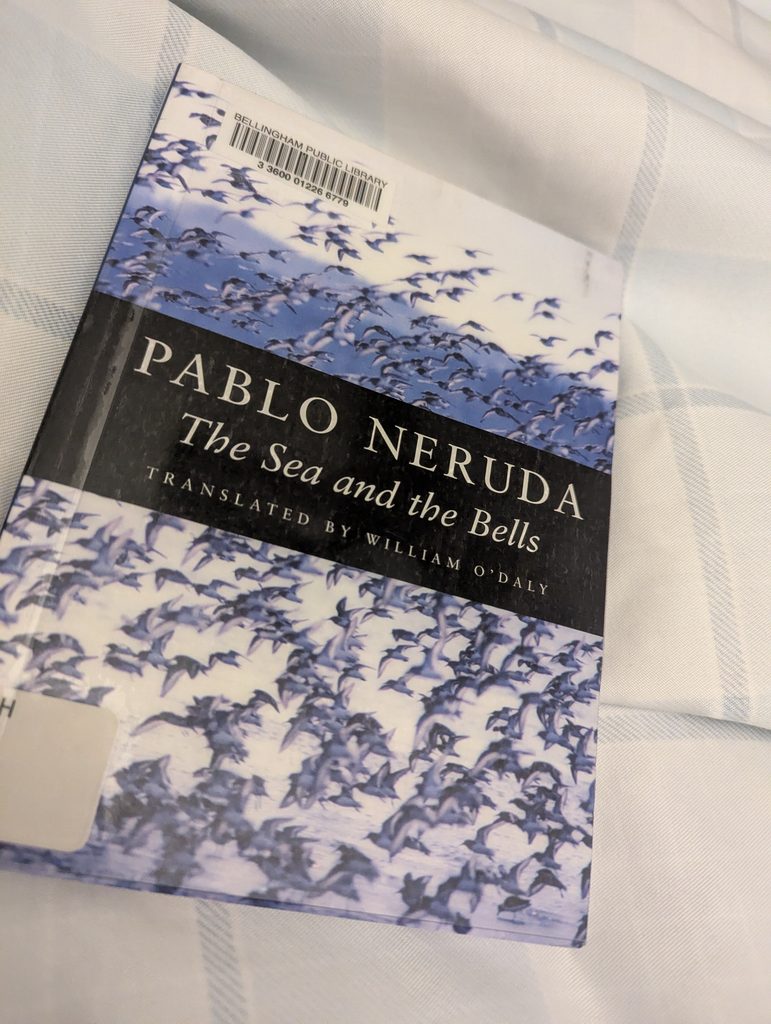
This was The Sea and the Bells for me. Also, because I feel like I understand Neruda’s desire to retreat from the noise of society. His love for nature, his wife, dreaming by the seaside is a heartsong for me personally. As the title suggests, the sea figures prominently in this book. As is the job of any poet to place us in the world as they see it – I could hear the crashing waves, the ringing of the various bells that dot the seaside. I could feel the love he had for the Land, his wife, and his country.
The fact that this is one of eight books of poems that Neruda worked on along with his memoir within the last year of his life, makes me feel the words are an urgent message from Neruda. He would die before that happened. His widow, Matilde, which figures prominently in his work had them published. And the world should be grateful for that, I believe. I am grateful for that.
Yet the volume is filled with this undercurrent of sad acceptance. Neruda was already sick when he wrote some of these poems. Ask anyone who has read this collection and they will tell you that the closing poem, ‘Finale,’ is devastating. Need to cry? Read that poem.
However, I am so enamored with ‘Salud!’ It is a salute to being kind in the face of terrible things, but being honest about it. It’s a nod and a chin wag to humanity’s truth that we all walk a path or have a story which the crowd about us has no idea about. It also makes me think about my elders and how they would always greet people along the street as they passed, as is the custom in Chile, where Neruda was born. In today’s world of long work commutes or remote working this kind of custom seems to have long past, but there was a story in this custom Neruda niggled under it and showed us, like any good writer does, the spiral of positive and negative all around a simple greeting.
This book displays each poem with the original Spanish on one side of the page, and the English translation opposite. Reading the Spanish version out loud and then re-reading the poem in English was an exercise in understanding for me, and I highly recommend if you read this volume, you try it that way, too.
I checked this one out from the library and now am on the hunt for my own copy to rest on my ‘comfort reads’ shelf. Neruda’s poetry feels like an old friend I can visit any time, so it deserves a spot there.
Grow Food For Free: The Sustainable, Zero-cost, Low-effort Way to a Bountiful Harvest by Huw Richards
This was an audio book for me, since Richards has a YouTube channel that I’ve long watched. His growing area in Wales is much like it is here in the PNW, and I’m always interested in how other people grow food. Richards has a deep permaculture background, too. The fact that the book is read by the author in his engaging Welsh accent was a bonus for me. It seemed to be a sound bath for some of my ancestors, as well.
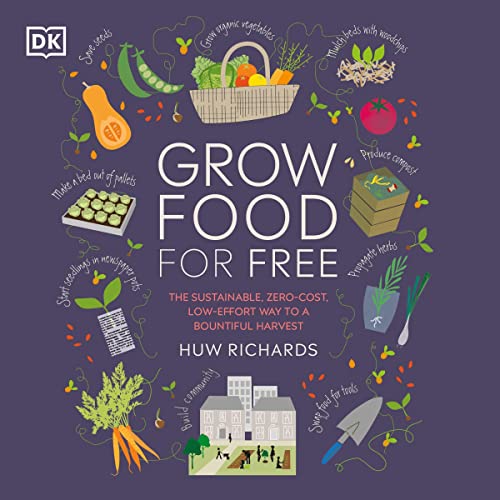
The books beginnings came as the author set himself a challenge to grow his own fruit and veg for a year. He succeeded and shares his tips, tricks, and tactics to fill your belly with homegrown food in this book.
He details some ways about sourcing materials, seed saving, composting, pest control, and even how he likes to eat some of the food (he’s a major beetroot fan). Some of the ways he sourced materials may be problematic for some readers/gardeners, mainly being cheered on with your goal to grow food. When I first started to turn what spaces I had into bringing in fresh food, there was confusion. Why would I want to grow basil when I can get it from the store. If you’ve eaten a strawberry straight from the garden or a tomato, or carrots, you understand.
Richards’ book focuses a lot about how friends, family, and neighbors all contributed to his challenge. Get yourself supporters like that and it will be a lot easier. Time is money, as we all know. Being able to delegate some of that sourcing helps these free food-growing a real possibility. If you do it solo, it will likely be harder.
The best thing about this book is that he really spends a lot of time talking about compost, and honestly, as a long time food-grower and permaculturist, this is the basis of any good food-growing efforts. For beginning gardeners you really need to understand this, and this book is great for that audience. Experienced gardeners may find that ‘there’s nothing new here.’
One word of caution to his tip to create inexpensive raised beds with old tires or pallets. As for pallets, this is definitely a low-cost gardening solution. Just make sure the wood is untreated. It should not be stamped with MB, which indicates it was treated with methyl bromide – a toxic chemical pesticide. Don’t use a pallet that has chemical stains on it. Skip painted or colored pallets, too. Look for HT or KD stamps on the pallets which indicate that the wood was safely treated.
Tires and the black plastic leach toxins into the soil and the roots of your plant take them up. You can grow non-edibles in tires, but I would paint them with an acrylic paint before employing them. That’s a whole other ask of your low-cost materials, however, and may be unapproachable for beginning gardeners. Instead, I would say, get on your local buy-nothing or craigslist free section. People give away raised beds and garden containers near daily – certainly seasonally. Don’t use tires to grow your food, friends. Just don’t. Even if you line it as Richards suggested with black visqueen before adding dirt. The tires
Next Month:
Queering The Runes: Reclaiming Ancestral Wisdom in Rune Magic & Mythology by Siri Vincent Plouff
This book has been in my TBR pile since it was released. I’m embarrassed it took me this long to get to it. But we all know the TBR pile is there to keep us reading. If there’s a book on Runes, you know I’m going to read it, as Runes have been my to-go-to divination tool and magic-making partner for decades. I’m always interested in how others approach it.
The Witch’s Name: Crafting Identities of Magical Power by Storm Faerywolf. Again another long-time TBR pile resident. I’m particularly interested in the sections on the history and mythology of spiritual names according to various cultures.
See you next month.