Runa Troy – Creative Crone

Practical Magic for Modern Seekers

Menu
  • Home
  • Creative Crone Shop
  • Courses & Consulting
  • Blog
  • ABOUT
  • Contact
    • Out & About With The Witch
    • Confidentiality & Security, Ethics & Terms
Menu

Category: PermieWitch

Flipping Off The System

Posted on August 9, 2022August 9, 2022 by runa

A Lesson in Onions & Worth

The 12 Tenets of Permaculture

In the last week or so I’ve harvested enough onions and garlic to use in our meals for months and months.  The red onion harvest alone should keep us in red onions for nine months. I look at these harvests as a big screw-you to the horrendous systems we have created on this planet. Growing my own food has been a constant rebellion for me against Earth-damaging capitalism. It also is a double fisted flip-off to the patriarchy, which continues to try to keep women from an autonomous existence or doing the things that bring us joy. Yes, friends, growing your own food is a big fuck you to the establishment. 

However, I’m also finding that some of the ways I have felt pressured to establish the worth of these efforts I’m ready to give the middle finger to as well. Over the years I have been growing food (more than 20), I’ve kept track in one way or another of our harvest totals. I say “our” harvest, but it’s mostly just this lone crone doing the #PermieWitch work around #VillaWestwyk. This spring, I found I was resisting the kinds of metrics found in pages of spreadsheets: how much lettuce did I just harvest? How many eggs has our flock produced for us? And what’s the break down between chickens, ducks, and geese? How much meat have I bartered for homemade sourdough bread? Blah, Blah, Blah! 

Part of my Onion Harvest

I know there’s abundance here. Who else do I need to prove it to? My spouse? Not even. I’m fortunate that my Writing Witch, Permie Witch, Green Witch, and the like are all fully supported by my partner. His father grew up on a farm. He knows how hard it is to grow food. Do I need to prove it to my community? This crone does not care if they think the 80 pounds of potatoes I grew last year (this year’s totals TBD) is a waste of my time. But being able to understand just how much I have produced is important. Of course I had to put my little rabble rousing ways on that, too. Let’s take a look at my Star System. No, we’re not talking astrology; however, my Taurus midheaven and North Node are all about Earth Healing.

For about a decade now I’ve referred to meals I’ve made containing ingredients from our gardens and pastures by a star count. Homegrown onions on the plate? One star. Freshly harvested potatoes on the plate? Another star. Greens from our hot house on the plate? You guessed it, another star. 

When this season it just gave me ZERO joy to worry about measuring, marking, and doing all that data work, I went back to the end result and the satisfaction that it brings. When I know or can share that there is at least one thing, if not many things on the plate for our meals that was grown or raised right here in this little 2-acre parcel – that, my friends, is just pure and utter delight and satisfaction. Consuming the stars on my plate – again one for each thing that is homegrown/made and ½ a star for those I bartered or procured from farming neighbors – is some of the regular joy and balance in my life. And again, as I’m fat and happy, I’m flipping off the establishment.

If you follow me on instagram, I regularly post photos of my meals and how many stars there are on our plates. Those metrics make me happy and smile. It tangibly shows the percentage of food I’m growing/raising is making an impact as opposed to data on a spreadsheet. For instance, breakfast this morning contained our eggs, zucchini, green beans, and chard. Four stars. Yum. 

Oftentimes, I verbally make note how much these items may have cost at our local market while eating this farm-to-table meal with my meal guests (in this COVID-19 World, that’s mostly The Viking). But then my Viking asked me how much the entire Onion harvest would cost us at the local farmer’s market. It took me a minute to do the arithmetic and I did have to do some measuring and whatnot, but the results were surprising. I conservatively estimated that my red onion harvest will shave approximately $130 off our grocery bill over the next six to nine months. Again, that’s conservative. If Whole Foods was selling it, it would probably be closer to $230. Ha! Plus I don’t have to worry about recalls because of listeria or any of that nonsense, which is worth even more money. I grow my veggies organically. They are fertilized with compost and seaweed tea. Pests are dealt with naturally (our slug and snail population has gone down so much, thank you ducks), in part due to our permaculture approach. That’s $130 in our savings and that’s not counting the sweet onions and garlic I harvested, too. 

I’ll take it. 

That simple question from my Aquarian hubby – who is so good at looking at situations from a different perspective – totally changed my perception about the work I’ve been doing. I started thinking about how so much of this late-stage capitalism is just fucking up our planet. How it devalues such cottage revenue as a vegetable garden or small-holding livestock. In short, there isn’t a societal value placed on the work that I do to feed my family and friends.  It’s looked at as a hobby. Whatever dude. Sweat your butt off in the summer trying to ensure a tomato harvest, or move your animals to higher ground during a flood event, or even just have a planter of strawberries on your patio, and talk to me about how it’s not valuable. 

However there is value. Part of that value is in the sustainability that we practice and are working hard to increase. And you can’t really put a price tag on that. Healing the Earth is priceless. Saving the planet one row of onions at a time is pretty fucking cool, though. 

This realization of value I recognized quickly fell within the Apply Self Regulation and Accept Feedback tenet of Permaculture (#SelfRegulate #AcceptFeedback). The lesson here came from myself first in that simple spreadsheet calculations were not bringing me joy. Is there food on our plate that we produced? Win. The other feedback came from The Viking. He saw the value in another way, not just the #ObtainAYield, another of the 12 tenets of Permaculture we’re applying to our lifestyle here at Villa Westwyk. That segues into the  Design From Patterns To Details tenet. Onions grow well here. They are low labor and work as pest control (#IntegrateDontSegregate) around my Brassicas. Surround your broccoli with onions. The pests will be way less. Also, when you cut an onion you grew yourself, the tears are worth it. 😉

A lot of the capitalist world may look at my daily life as less than, but I understand the Magic that is being created by focusing on healing the Earth (and meanwhile myself and my family – #EatYourselfWell) and working with her is more valuable than metrics and a paycheck. But, honestly, I am creating value and abundance, even if the patriarchy and capitalism can’t see it. I see it. Therefore, I’ll continue to rebel in my own way.

How about you? Are you growing food? Even herbs? Where can you increase your own food security? Please let me know in the comments below. 

I would like to acknowledge that Villa Westwyk resides on the ancestral homelands of the Coast Salish Peoples, who have lived in the Salish Sea basin, throughout the San Juan Islands and the North Cascades watershed, from time immemorial. I hold the deepest respect and gratitude for our Indigenous neighbors, the Lummi Nation and Nooksack Tribe, for their enduring care and protection of our shared lands and waterways.

Kitchen Witchery meets Permaculture For The Fur Babies

Posted on May 19, 2022May 19, 2022 by runa

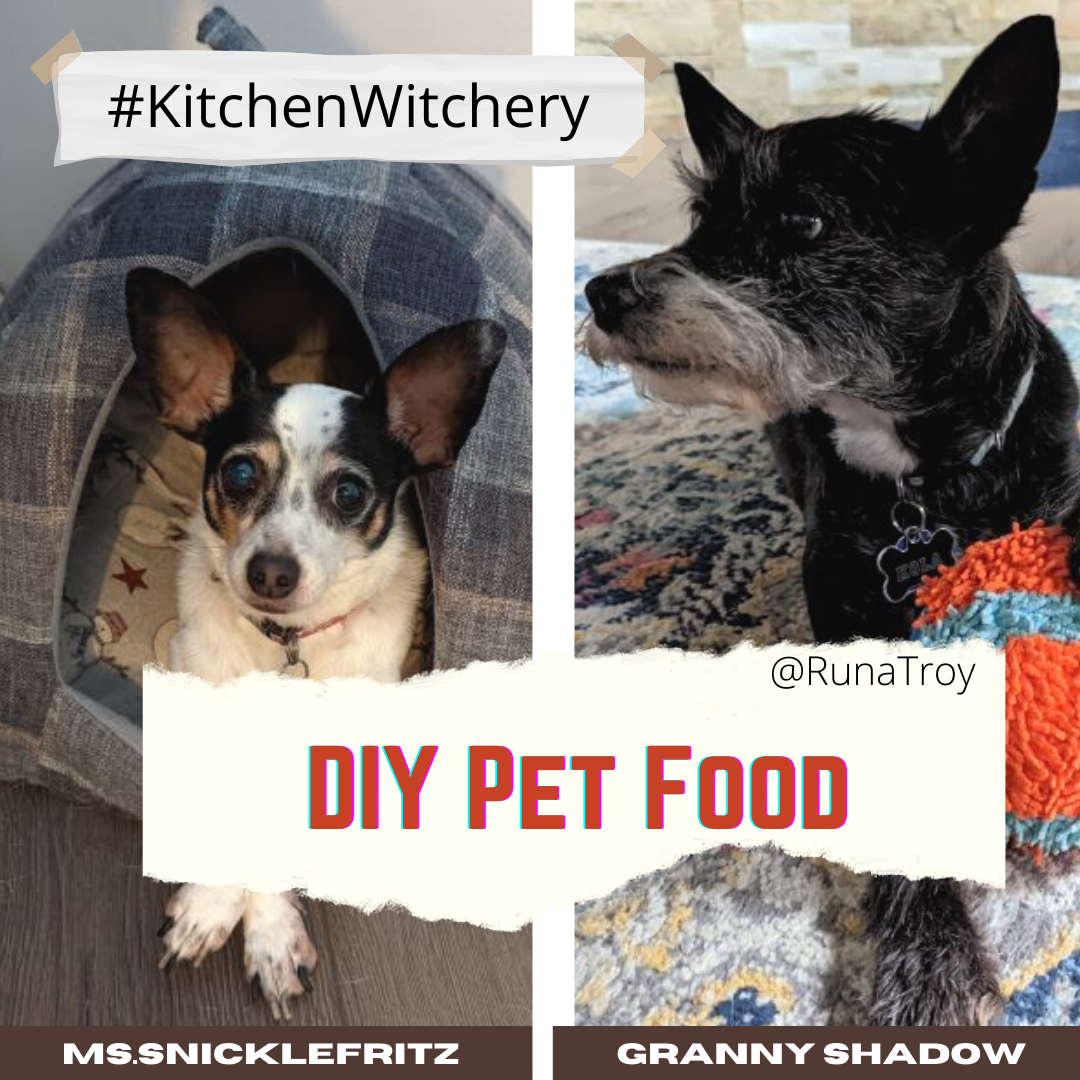
In honor of National Pet Rescue Day – DIY Magic Pet Food

Ms.SnickleFritz & Granny Shadow have bespoke food. Lucky Familiars.

May 20 is National Pet Rescue Day. My current ‘Puppers,’ as The Viking and I call them, are rescues. I’ve always preferred to adopt rescues than purchase my pet because I find they are just so loyal and loving. The added benefit that an animal in need is being cared for is a bonus. I’m not about to get into puppy mills and all that nonsense, or the fact that there are likely just as many feral cats in your neighborhood as there are people. Rescues are a kinder way for the animals and our planet. This Witch is all about kinder to animals and the planet.

Enter Kitchen Witchery and Permaculture to solve a problem. In Permaculture, you Design from Patterns to Details and the pattern was non sustainable food for my familiars. The details of what would make it sustainable begin to emerge.

These Witch’s Familiars, our canine yin and yang, are getting up there in age and now have special dietary requirements. Currently they both have medicated kibble. On top of the kibble we put a wet food, because they’ve made it clear the kibble alone is not very satisfying. Kind of how we have to put cinnamon and fruit on our oatmeal to actually eat it. Also much of the nonmedicated kibble is mostly water and does not have the protein that most canines need.

After finding that most of the softer foods out there are so full of things that my puppers do not need, are horribly expensive, and produce so much waste in its packaging, I needed something more economical, sustainable, and that the furkids would enjoy. About this time last year I started experimenting with making my own canned dog food. The idea to even explore that came to me because I often will make a big batch of stew or soup and I either need to preserve the leftovers, or was finding at least one pint would be used to augment Ms. Snicklefritz and Granny Shadow’s dinner. Much like how I approach the food that The Viking and I consume, I really wanted to know what my dogs were eating. I recognized that the best way to do that was to make it myself. The additional opportunity to make the food a ritual and infuse it with Magic, well, I couldn’t resist that.

Lamb, kale, carrots, and a small bit of sweet potato made this batch of dog food for my pups.

The intentions I put into each batch are all about protection, health, and, of course, love. I’m sharing this, as mentioned in the title, in honor of National Pet Rescue Day and in hopes that it might inspire you to look a little closer into your own food as well as that of your own familiar. As a Permie Witch, doing this follows the permaculture principle of Producing No Waste. Every part of our resources gets used. It is to a lesser degree aligning with two other of the permaculture principles: Obtain A Yield, and Creatively Use & Respond to Change. A weaker argument could be made for the tenet of Use & Value Renewables. As we begin the growing, hatching, and birthing season here at Villa Westwyk, we eat with the seasons here as much as possible. It’s a slow change, which also is within the permaculture lifestyle: Choose Small, Slow Solutions. Needless to say, we’re all in here at the covenstead with this “chore,” which is really a ritual and spell. This is about the moment when my youngest, Dragon Son, would say, “you feel me?”

I basically take a left over chicken carcass, stew bone, or even the remnants of a whole fish, bring it to a boil, then simmer several hours. You just need enough water to cover the carcass…don’t go crazy unless you plan to make soup or such soon, or can the broth (that’s what I do). I make broth in a pasta maker, that way the carcass and the meat still on it is easily drained, cooled, and picked through. Sometimes I will refrigerate the broth overnight before continuing with the pet food batch, so I can skim the fat off and use an appropriate proportion with it to cook the veggies in. But you could use oil, butter, bacon drippings, whatever you have on hand.

This is where my protein to make the pet food comes in, so you could buy store bought, but the bone broth provides so many nutrients and is a superbly economical way to acquire pet food. If you want to go full-on Midgardening Witchery, you’ll can the extra broth for the human pets in your life. 😉 My 9 half-pint batches start normally with about 1 1/2 cups to 2 cups of protein. y last batch the protein portion was about 2 cups; I let the protein amount drive the rest of the recipe. If you homeschool, this is a great exercise in fractions and parts of the whole. 😉

I cook up the bite-size veggies with a little bit of fat, add the meat plucked from the bones, make a roux, add the broth, let it cook down a bit and can it up. Alternatively, you may freeze it at this point, or if you can use your batch up within a week’s time, you can keep it in the refrigerator.

If you know how to make biscuits and gravy, or any kind of a roux, this recipe will likely be easy for you. The below recipe makes about 9 half-pint mason jars. If you want to make pint or quart, do the appropriate math. 😉

Equipment:

Broth pot (stew pot with a colander in it, like a pasta cooker)

Cauldron (Dutch oven pot)

Pressure Canner with Jars/Rings/Lids or Freezer containers

Ingredients:

1 part Protein (leftover chicken carcass, ham bone, lamb leg bone, etc.)

1/4 part Fat (bacon drippings, schmaltz)

1 part Veggies (cats and dogs need their veggies, too)

1 part Something to help meld it together (sweet potato, beans, potato, brown rice, etc.)

~ 2 tablespoons to 1/4 cup Flour

~ 2 cups Broth (double if making quart batches)

Salt (optional)

This batch includes rabbit, chicken, broccoli, and garbanzo beans.

Instructions:

  1. Make your broth. Put soup bones, poultry carcass, etc. in a pot covered with water. You’re only going to need about 2 cups tops to make a batch of pet food (I do 7-9 half pints at a time). But make as much as you like. If what you’re making broth with was unseasoned (not often on my covenstead) feel free to add a pinch or two of salt. Salt is good for your animals, too. But just like us, too much is not good either to taste or for their bodies.
  2. Once broth is made, remove the bones and separate any meat/skin/giblets out to include in the pet food. As you do this, put the intention of keeping the sick away from your beloved familiars. You are separating the good stuff versus the discard. Set the meat aside and discard the bones. If you’re going to can your pet food, this is where you’ll need to sanitize your jars, lids, and rings and inspect your pressure canner.
  3. Into your cauldron, add a bit of fat (butter, schmaltz, bacon drippings, oil) and heat on medium heat. Sauté the chopped up vegetables until tender. I put the veggies in saying, “Here’s to my familiar’s health.” Simple, but effective. Each time I stir the veggies I say it again, “Here’s to my familiar’s health.”
  4. Once the veggies are tender, add back in the meat you plucked from the bone(s), and sauté with the veggies until warmed (about one to two minutes). If you have things like potatoes or beans in your batch, give them a squish with your cooking spoon to help thicken things up in the next step. Mashing the ingredients in is optional, but my somewhat toothless wonders love it this way (just like aging people, pets sometimes lose teeth as they age). I do a simple stir three times clockwise (aka sunwise), putting a whole lotta love for these furkids into the cauldron’s contents.
  5. Depending on how full your pot is, you’re going to need between 2 tablespoons to 1/4 cup of flour. You are making a roux with the veggies and meat. Sprinkle the flour on the protein and veggies envisioning the flour as extra protection and mix it all in and let it cook for about two minutes.
  6. Add in your broth, and simmer until reduced somewhat. You know what wet pet food consistency looks like. You’re looking to get the same. Depending on the size of your batch, this can take five to 20 minutes. My 9 half-pint-jar-batch takes about seven minutes. If you’re filling a canner or freezing quart size containers, then it will go closer to 20 minutes.
  7. At this point you can package up your food and freeze, but if you’re going to pressure can, I always use half-pint (aka jelly) jars and can get up to 9 jars in my canner. Follow the manufacturers instructions for your personal pressure canner. Can the pet food at 11 pounds pressure for 15 minutes for half pint; 25 minutes for pint; 35 minutes for quart (for you folx with more pets or large pets, quart size might work best).
  8. Label your food with the ingredients & date and watch your pets gobble it up. Honestly, this is food that humans could eat, too. So, if you don’t label it, no one will be harmed. LOL. Regardless, you know whether man or beast, they are going to dig it. If I’m feeling particularly Witchy, I might put an appropriate sigil on the jar.
  9. When there’s only one jar left, be sure to make another batch. I also set aside one jar to always have in the pantry to bring abundance for my familiars: food, water, shelter, and love. If you do this “cupboard Magic” be sure to rotate the abundance anchor (your extra jar) so that the food doesn’t go bad. That’s some negative energy there. These will last in your cupboard easily for up to six months.

I hope that this helps you amp up your self sufficiency and self reliance, as well as brings a little Magic for your familiars/pets. Also, please join me in the Adopt Don’t Shop philosophy. And please give to your favorite animal advocate nonprofit. The Viking and I support the ASPCA regularly and have been known to gift animal rescue donations in honor of our loved ones.

Please let me know if you have any questions in the comments. May this recipe bless you and your pets. Now go snuggle your familiar. 😉

Hatching Season!

Posted on May 17, 2022May 17, 2022 by runa

Villa Westwyk welcomes goslings!

Villa Westwyk’s Pilgrim Goose Fam.

It’s hard to get a photo of our little goose family all together, because clearly they are SUPER comfortable. Can you spot all seven goslings?

Currently we’re getting ready for an unseasonably cold front coming in. Honestly, Spring really has been a warm winter here in the PNW. But our snow pack is getting above average and that is good for the whole of Western Washington, where our covenstead is. So I’m glad the goslings are filling out and getting all the grass they can handle to stay warm. They also get supplemental feed and vitamin water to help mitigate for problems that can befall them in the early days of their life. Mama Eva and Papa Willie are doing great. Willie even made sure I knew he was still a protective dad when I went to freshen water and gosling feed this morning. It was all posturing, but have you seen the teeth on geese? Literally, Cobra Chickens. hehe.

On Friday the 13th, our lovely Pilgrim Goose successfully hatched seven goslings. She needed a little help with two of them, and we were there to help provide ICU care, which meant we needed to bring them inside and warm them up, hydrate them, and get them to the point of reintegration. Nature is amazing, and the two ICU patients were reunited with their siblings and parents in a day’s time. Eva was busy dealing with 5 other hatchlings and sitting still on the other eggs, so we were happy to do our part as bipedal assistants. Spoiler alert! 4 eggs were nonviable, and 4 goslings perished before completely hatching, which is par for the course. Only the strong survive in nature. Both of those things happen traditionally when you let Mother Nature lead the way. It’s a reason they have such large clutches of eggs. Eva sat on 15 eggs for 30 days! What a trooper! I buried the perished ones in our “forest” and the nonviable eggs went into the compost. Both will return to the land. I find that sentiment Magical. Being a part of this land is so much a part of my Magical practice of Midgardening Witchery.

Our impromptu ICU: a box with wood shavings and a heating pad on top.

This hatching is a huge accomplishment for our efforts at sustainability and self reliance. This month, we’ve only been the keepers of this land* for two years. (Wow, what a crazy two years!) Every creature, flora and fauna, here on little two-acre permaculture holding, is central to what we’re trying to accomplish here. The geese manage the pasture by being living lawn mowers (no gas or other power needed). We are slowly building safety infrastructure so their protected pasture is larger and larger. What they have is more than enough, but I’m all for giving them as best a life as I can.

When they keep the pasture trim, it’s easier to see invasive species, which was a problem when we first acquired this land* and in turn, lets native grasses and plants flourish. They are great guardians of the property, too. We know when predators or visitors are about. And are they cute as hatchlings. To see them flap their little wings and make their little peep is pure joy making. This Crone Life is more and more about finding joy, so they are certainly a part of it.

Here I will provide a content warning: If ethically raised meat is upsetting for you, please prepare yourself to continue, or maybe go back to the cute photos above.

Yes, some of these goslings will give back to this land* in a different way. They will feed our family. And honestly, eating meat is a personal choice, and one that my family has worked hard to do sustainably and ethically. I know how these animals are raised and they will be dispatched in the most honorable and pain-free way possible. But that dispatching is also for the health of the animals. Too many ganders is upsetting to the geese within the gaggle (I know some Witches out there that are nodding along…). Too many ganders would have the ducks upset, too, because there’s a good chance the ganders would try to mate with the ducks — and although it’s not harmful to them, the size difference could cause injury. And we already have 2 drakes for 9 ducks. Just barely the right ratio there. We also use every part of the harvest, creating not just meals, but bone broth, dog food (a post on that coming Thursday), and even Magical Goods (a post on that coming soon).

Living a permaculture lifestyle is all about diversity, harmony, and balance. This includes the animals on the property (including the humans!). One of the 12 principles of permaculture is: Use and Value Diversity. That’s why we have not just geese, but ducks and chickens, too. Eventually, I hope to provide not just to my neighbors who right now receive harvests from my land in barter, but perhaps the larger community. But permaculture is about using small, slow solutions. After two years we have 10 chickens, 11 ducks, and now 9, but soon to be 3 geese. Slow, incremental growth is healthy.

Thank you for coming along on this journey with me. I hope you learned something here. If you did, please let me know in the comments. I honestly believe that applying the permaculture principles to every part of our lives helps mitigate for and prevent problems and allows for healthy living all the way around. And in the meantime, I get to spam the blog, Instagram, and Twitter with Gosling images and videos.

Papa Willie takes the Goslings For A Walk To Give Mama Eva a break.

*I would like to acknowledge that Villa Westwyk resides on the ancestral homelands of the Coast Salish Peoples, who have lived in the Salish Sea basin, throughout the San Juan Islands and the North Cascades watershed, from time immemorial. I hold the deepest respect and gratitude for our Indigenous neighbors, the Lummi Nation and Nooksack Tribe, for their enduring care and protection of our shared lands and waterways. I vow to live in harmony with and be a steward of this land and its waterways as they have.

  • Previous
  • 1
  • 2

Writing Witch

My book with Llewellyn Worldwide: Magic In Your Cup: A Witch’s Guide To Sippable Spellcraft. Available everywhere books sold!
© 2026 Runa Troy – Creative Crone | Powered by Minimalist Blog WordPress Theme